​The tool rake angle is one of the most critical parameters of cutting tools, directly determining cutting performance, service life, and machining quality. Whether you are a mechanical processing practitioner or an enthusiast interested in manufacturing, mastering the core knowledge of the tool rake angle can help you quickly understand the working principle of cutting tools.
​

Definition and Measurement of Tool Rake Angle​

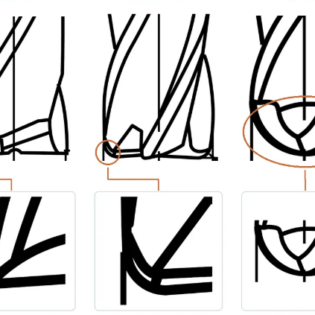
The rake angle (γ₀) refers to the angle between the rake face and the base surface, measured in the orthogonal plane (P₀). It has clear positive and negative distinctions, and corresponding rake angles can also be measured in different sections to adapt to specific machining scenarios.
​tool rake angle

Core Functions of Tool Rake Angle​

The impact of the rake angle focuses on four key dimensions:​

Cutting Force and Heat: The larger the rake angle, the smaller the cutting deformation and friction, resulting in reduced cutting force, power, and heat. For every 1° increase in the rake angle, the cutting force decreases by approximately 1%, and this effect is more significant when machining plastic materials.​

Cutting Edge Strength and Heat Dissipation: Increasing the tool rake angle makes the cutting edge sharper but reduces its strength and heat dissipation volume, leading to easy chipping. A negative rake angle enhances impact resistance and heat dissipation, suitable for hard materials or intermittent cutting.​

Chip Morphology and Chip Breaking: A large  rake angle makes chips difficult to break (needing chip breakers); a small rake angle promotes chip brittle fracture.​

Machined Surface Quality: A large rake angle inhibits built-up edges and vibration, improving surface quality; a negative rake angle may cause vibration and reduce quality.

​Core Popular Science of Tool Rake Angle 2

Key Selection Principles of Tool Rake Angle​

The core is to balance “sharpness” and “robustness”, with three key factors:​

Workpiece Material: Plastic materials (steel, aluminum alloy) → 10°~30°; brittle materials (cast iron, bronze) → 5°~15°; extra-hard materials (hardened steel) → -20°~-5°.​

Tool Material: High-speed steel → 5°~10° larger than carbide; carbide → small/negative rake angle; ceramic/CBN → -15°~-4°.​

Machining Conditions: Rough machining/intermittent cutting → small/negative rake angle; finish machining → large rake angle; poor rigidity/insufficient power → large rake angle; CNC/automated lines → small rake angle for stable life.

Core Popular Science of Tool Rake Angle 3Core Popular Science of Tool Rake Angle 4Core Popular Science of Tool Rake Angle 5

​     

Common Tool Rake Angle Reference (Simplified Table)​

Turning Tools​

​
Tool Material​
Workpiece Material​
Tool Rake Angle​
High-Speed Steel​
Medium carbon steel​
15°~20°​
High-Speed Steel​
Low carbon steel​
20°~25°​
High-Speed Steel​
Aluminum alloy/red copper​
30°~35°​
High-Speed Steel​
Gray cast iron​
10°~15°​
karbit​
Carbon steel/alloy steel​
10°~20°​
karbit​
Paslanmaz çelik​
15°~20°​
karbit​
Gray cast iron​
5°~15°​
karbit​
Hardened steel (HRC50~60)​
-5°~-15°​
karbit​
Copper alloy​
10°~15°​

​

Milling Cutters​

​
Tool Material​
Workpiece Material​
Tool Rake Angle​
High-Speed Steel​
Low/medium-strength steel​
15°~25°​
High-Speed Steel​
Gray cast iron​
5°~10°​
High-Speed Steel​
Aluminum alloy​
15°~35°​
High-Speed Steel​
Plastic/wood​
25°~30°​
karbit​
Steel​
10°~20°​
karbit​
Cast iron​
5°~10°​
karbit​
Hardened steel (HRC55+)​
-10°~-15°​
karbit​
Aluminum alloy​
15°~25°​

​

End Mills​

​
Tool Type​
Application Scenario​
Edge Position​
Tool Rake Angle​
Solid Carbide (General)​
Most steels/cast irons​
Side Edge​
12°~15°​
Solid Carbide (General)​
Most steels/cast irons​
End Edge​
5°~8°​
Special (Aluminum)​
Aluminum alloy​
Side Edge​
15°~20°​
Special (Stainless)​
Paslanmaz çelik​
Side Edge​
12°~15°​
Special (Hardened)​
Hardened steel (HRC50+)​
Side Edge​
-5°~-10°​

​

Special Forms of Tool Rake Angle​

Positive Rake Angle with Chamfer: Enhances cutting edge strength, suitable for carbide rough machining/intermittent cutting.​

Negative Rake Angle Type: Good impact resistance and heat dissipation, suitable for high-strength hard materials.​

Curved Surface Type (with Chip Breaker): Promotes chip breaking, suitable for plastic materials.

Core Popular Science of Tool Rake Angle 6​

özet​

The essence of the rake angle is the “balance between sharpness and robustness”. A large rake angle enables light cutting and good surface quality but has weak cutting edge strength. A small/negative rake angle provides a robust cutting edge and strong impact resistance but generates large cutting force. In practical applications, combining workpiece materials, tool materials, and machining conditions with special forms of tool rake angle achieves optimal cutting effects.

Bir cevap yazın

E-posta hesabınız yayımlanmayacak. Gerekli alanlar * ile işaretlenmişlerdir